
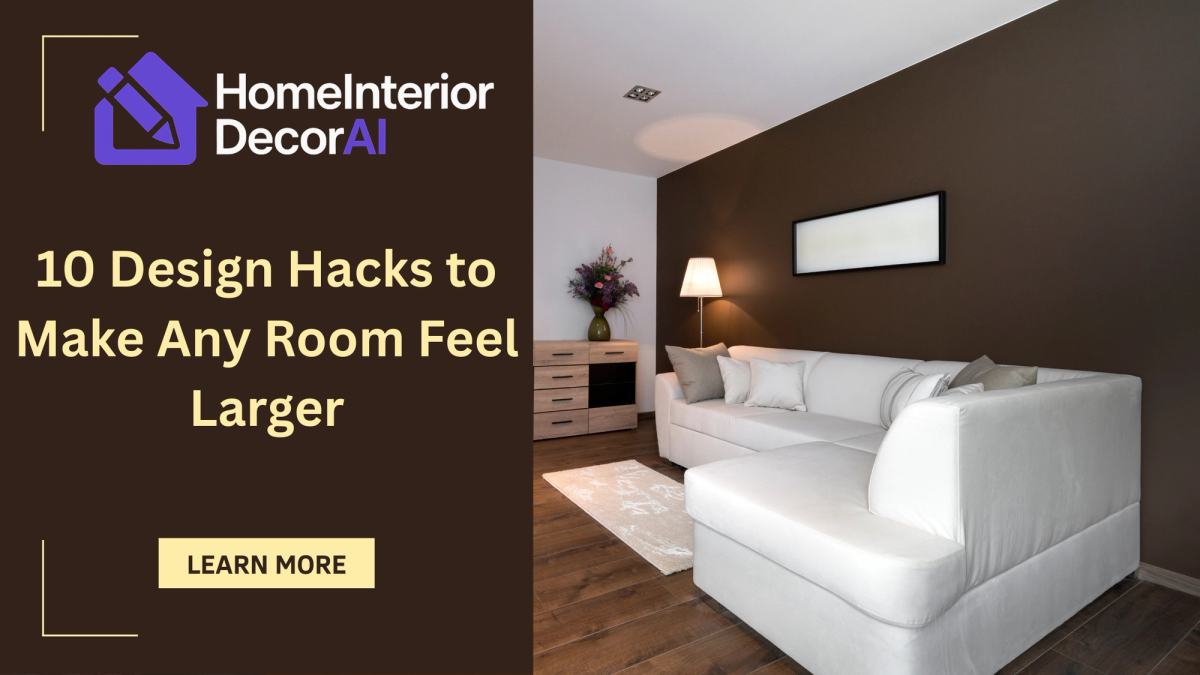
The Ultimate Guide to Mastering Spatial Illusion and Using AI to Generate Your Perfect Home
For many homeowners and apartment dwellers, the challenge of interior design isn't just about style—it’s about square footage. An "awkward" layout or a cramped living area can feel stifling, but interior design is often a game of optical illusions. You don’t necessarily need to knock down walls to create a sense of airiness; you just need to change how the eye perceives the boundaries of the room.
By mastering a few foundational principles, you can trick the brain into seeing depth, height, and space where there was none before. Here is how to transform your home using evergreen design logic and modern AI visualization.
1. The "Leggy" Furniture Rule
In a small room, visual floor space is your most valuable currency. Avoid "boxy" furniture that sits flat on the ground, as it acts like a visual roadblock. Instead, choose sofas, chairs, and sideboards with tapered legs. When the eye can see the floor extending under the furniture, the room feels significantly more expansive.
2. Master the Art of Scale and Proportion
It sounds counter-intuitive, but one large statement piece—like a properly sized sectional sofa—often makes a room look larger than five small, cluttered pieces of furniture. Minimizing "visual noise" allows the room to feel intentional rather than crowded.
3. Use the "Low-to-the-Ground" Strategy
High-backed chairs and tall, heavy cabinets can "close in" a room by occupying the vertical center. By choosing lower-profile furniture, you leave more vertical space open, which makes the ceiling feel higher and the air feel thinner.
4. The Mirror Illusion
This is a classic for a reason: it works. A large floor mirror or a mirrored wall reflects light and the view from the window, effectively "doubling" the visual space. For the best results, place the mirror opposite your primary light source.
5. Paint with a Monochromatic Palette
When walls, trim, and doors are painted in the same color, the "edges" of the room disappear. Contrast (like dark baseboards with light walls) breaks the room into smaller boxes. Using a single, light shade allows the eye to sweep across the space uninterrupted.
6. Draw the Eye Upward with Verticality
If you can’t expand horizontally, go vertical. Use floor-to-ceiling bookshelves or hang your curtains a few inches below the ceiling rather than right at the window frame. This draws the eye to the highest point of the room, emphasizing height over narrowness.
7. Choose "See-Through" Materials
Acrylic (Lucite) coffee tables or glass-top desks are known as "ghost" furniture. They provide the function you need without taking up any "visual weight." They occupy space physically, but disappear visually.
8. Strategic Lighting: Avoid the "Big Light"
A single overhead light creates shadows that make corners feel smaller and closer. Instead, use "layered lighting." Place a floor lamp in one corner and a table lamp in another. Lighting up the far corners of a room "pushes" the walls out.
9. Clear the Walkways
If you have to zigzag through your room, the room is too crowded. Ensure there is a clear path of travel. If a piece of furniture obstructs a natural walking path, it is a "spatial tax" that makes the room feel cramped and frustrating.
10. The Power of "Negative Space"
Every wall doesn't need a picture, and every shelf doesn't need a knick-knack. Leaving some "white space" gives the eyes a place to rest. This intentional emptiness is what creates a feeling of luxury and calm in even the smallest studios.
From Inspiration to Reality: Generate Your New Space
Applying these ten principles manually can take hours of measuring and moving heavy furniture. To see these spatial hacks applied to your specific home instantly, you can use the home-interior-decor.com AI tool.
Our AI allows you to move beyond imagination. By generating a digital version of your room, you can experiment with different design styles—like Minimalist or Modern—that prioritize clean lines and open spaces before you spend a single dollar on new decor.
To see your space transformed:
- Go to our homepage at home-interior-decor.com.
- Upload a photo of your current room or the space you want to remodel.
- Select a Design Style and let the AI generate a new, professionally styled version of your room.
Whether you are dealing with a narrow studio or a cluttered living room, you no longer have to guess. Use our website to generate a version of your home that feels twice as large and twice as stylish.


